Enterprise Customer Relationship Management (CRM) Systems
At Helicon INC, we recognize that customer data is the lifeblood of modern enterprise. Our CRM integration services go beyond basic out-of-the-box setups; we architect centralized data hubs that empower your sales, marketing, and support teams to operate with total synchronicity. By deploying a heavily optimized CRM architecture tailored to your unique workflows, we transform fragmented data into actionable revenue pipelines.
Why Intelligent CRM Architecture Matters
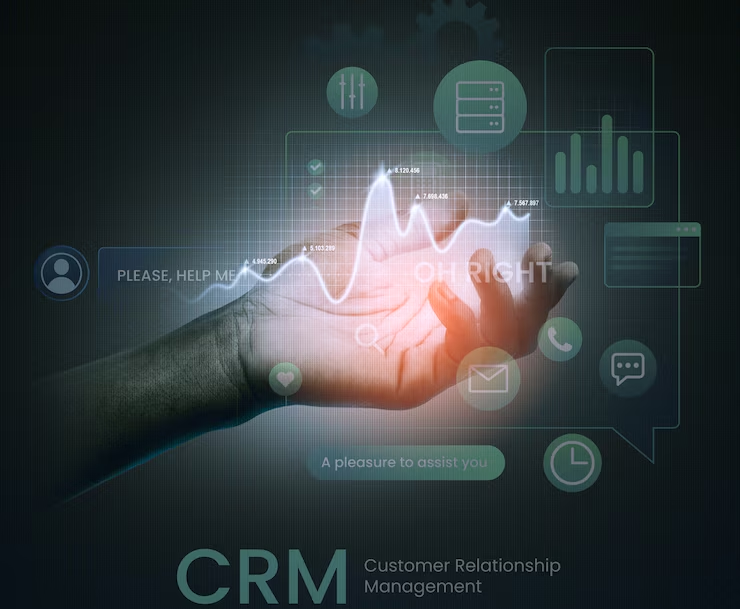
In a hyper-competitive B2B and B2C landscape, siloed data kills growth. A properly engineered CRM system allows you to consolidate every customer interaction—from initial marketing touchpoints to post-sale support—into a single, unified dashboard. This holistic visibility ensures your team never drops a lead, accelerates the sales cycle through automation, and scales your customer retention strategies flawlessly.
Our Core CRM Capabilities
We manage the entire lifecycle of your CRM infrastructure, from initial process auditing to advanced API integrations.
1. Architecture & Process Auditing
Before writing a line of code or recommending a platform, our analysts map your current sales pipelines, operational bottlenecks, and data flows. We design a CRM blueprint that aligns strictly with your revenue goals and user adoption strategies.
2. Platform Selection & Customization
Whether your enterprise requires the vast ecosystem of Salesforce, the inbound machinery of HubSpot, or a completely bespoke, custom-built CRM from the ground up, we deploy the exact stack needed to match your technical requirements and budget.
3. Workflow Automation
We eliminate manual data entry. Our developers construct automated logic rules within your CRM to auto-assign leads, trigger follow-up sequences, escalate support tickets, and update pipeline stages instantly based on customer behavior.
4. Secure Data Migration & API Integration
Transitioning systems shouldn't disrupt operations. We execute zero-downtime, encrypted data migrations to preserve your historical intelligence. We then build robust APIs to connect your new CRM seamlessly with your ERP, accounting software, and external marketing tools.
5. Advanced Analytics & Revenue Forecasting
We build custom executive dashboards that cut through the noise. Track your exact customer acquisition costs (CAC), lifetime value (LTV), sales team velocity, and run predictive forecasting models so leadership can make data-driven decisions instantly.
The Helicon CRM Advantage
- 360-Degree Visibility: Eradicate data silos and unite your sales and marketing departments.
- Frictionless Scaling: Our architectures handle 10 leads or 10 million leads with the exact same performance stability.
- Maximized User Adoption: We design intuitive interfaces and provide hands-on training so your team actually *uses* the software.
- Continuous Support: Dedicated SLA coverage, ongoing maintenance, and iterative upgrades as your business evolves.